On September 12, China National Chemical Engineering and Xi’an Jiaotong University held a signing ceremony for the strategic cooperation agreement in Xi’an. Mo Dingge, Secretary of the Party Committee and Chairman of China National Chemical Engineering, and Zhang Liqun, Member of the Chinese Academy of Engineering and President of Xi’an Jiaotong University, attended the ceremony to witness the signing, and held discussions on further deepening university-enterprise strategic cooperation. Sun Zao, Deputy Secretary of the Party Committee of Xi’an Jiaotong University, and Zhao Tao, Member of the Party Committee and Deputy General Manager of China National Chemical Engineering, participated in the event.
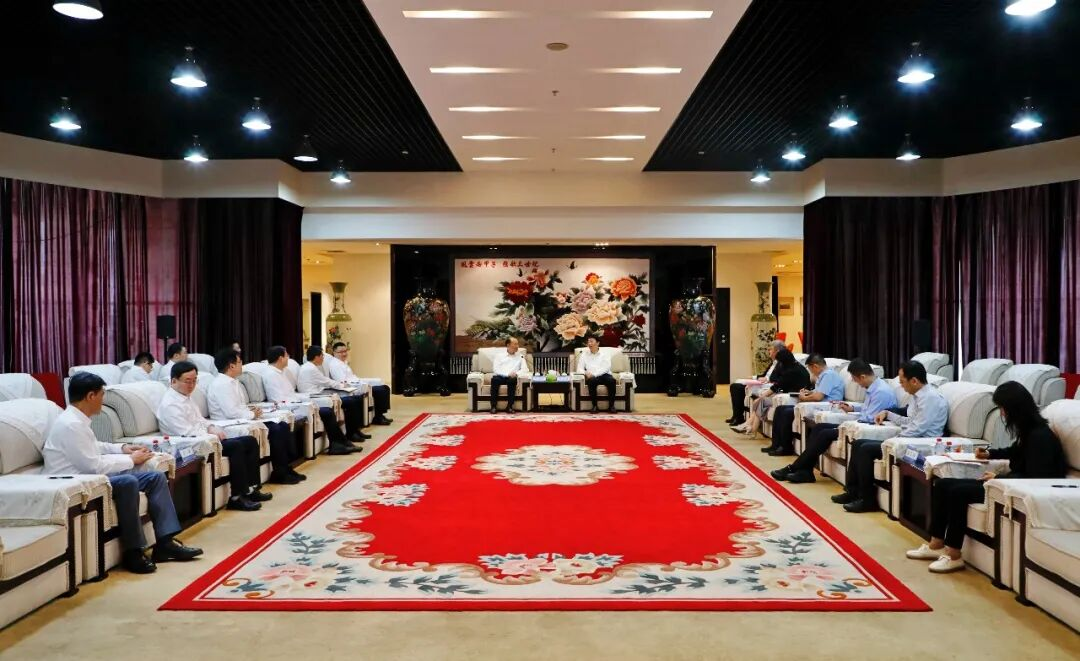
Mo Dingge congratulated Xi’an Jiaotong University on its remarkable achievements over the 130 years since its foundation, and introduced the development history and industrial layout of China National Chemical Engineering. He stated that as the national team of China’s chemical industry and a pacesetter in global chemical engineering, China National Chemical Engineering is vigorously promoting the in-depth integration of scientific and technological innovation with industrial innovation. The Group is thoroughly implementing the “T+EPC” and “T+Industry” development models and accelerating efforts to build a world-class innovative engineering company. He expressed the hope that both sides will further leverage their respective strengths in scientific research and industry, speed up the two-way flow of innovation factors, and demonstrate value and contribute to realizing national self-reliance and strength in science and technology.
Zhang Liqun welcomed Mo Dingge’s visit and briefed him on the university’s historical evolution, discipline development and innovation platform development. He noted that the university adheres to the development goal of “Taking Root in Western China, Serving the Nation, Pursuing World-Class Excellence”. In fields such as energy and power, mechanical engineering, chemistry and chemical engineering, and materials science, it continuously promotes integrated development of education, science and technology, talent cultivation and industry, and accelerates the transformation of scientific and technological achievements into real productive forces. It is expected that both parties will take this signing as an opportunity to jointly foster a new pattern of university-enterprise collaborative innovation and mutually beneficial development.
Under the strategic cooperation agreement, the two sides will carry out all-round cooperation in tackling key scientific research projects, commercialization of innovation outcomes, talent training and exchange, platform co-construction and resource sharing.
